

Top business debit cards for travel in 2026: Unveiling the advantages
With rising FX rates, hidden transaction fees, and security concerns, choosing the right travel card…

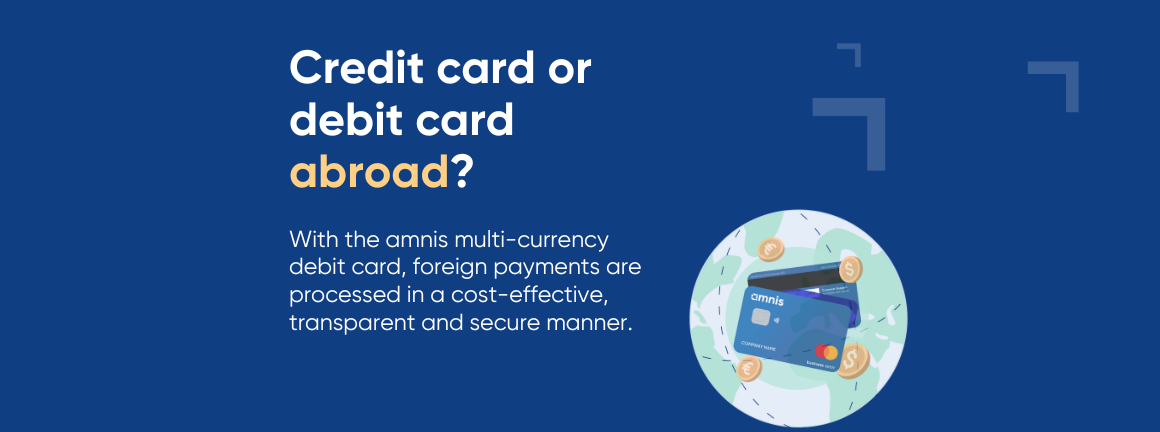
Credit or debit card abroad? This is a question that travelers or companies ask themselves when making transactions abroad or in a foreign currency. Debit and credit cards offer different options for making uncomplicated payments abroad. However, it is important that cardholders pay attention to exchange rates and hidden fees in order to keep costs low. Everything you need to know about credit or debit cards abroad can be found in the following article.
When using debit or credit cards abroad, there are several important factors to consider to ensure easy transactions and to avoid unnecessary fees:
The difference between debit and credit cards lies primarily in the fact that the debit card is linked to the bank account and payments are made in real time, whereas credit card holders borrow the money from banks to repay it with interest over fixed time periods.
Both cards are linked to a payment network such as Mastercard, VISA or American Express and have a card number of 12-16 characters, an expiration date and a CVV/CVC code on their back. Modern cards are also linked to other payment service providers such as Apple Pay in order to process payments via mobile devices.
Fraud protection is one of the most important benefits, as credit cards abroad usually provide zero liability for unauthorized transactions, meaning you’re not responsible for fraudulent charges if reported promptly.
However, credit cards are among the types of credit with the highest interest rates in the world, so both end users and companies should monitor and weigh up their use. A credit card is issued with a loan, which, depending on the provider, usually has to be repaid once a month plus interest. This difference has a major impact on security and the cost factor. This is particularly important for companies that issue a large number of credit cards to their employees.
Debit cards are a solid option for cost-aware travelers, as they offer direct access to your bank account without the potential for overspending. One of the key benefits is the ability to withdraw cash from ATMs with relatively low fees, depending on your bank. However, since they are directly tied to your bank account, it’s important to be mindful of potential fraud risks while traveling.
This is where prepaid debit cards come into play. While not linked to your regular bank account, these cards offer all the advantages of a normal card, but without the risks of a regular overdraft. Instead, a certain amount of money is deposited in advance that can be spent with the card. This means that only the money that is at your disposal can be used.
To put it in a nutshell: most end users (and even companies) do not know how much they pay in fees for a credit or debit card abroad. The fact that payment networks such as VISA or American Express automatically convert currencies comes with high and non-transparent fees.
The most common international payment fees are:
Credit cards are likely to remain more widely accepted than debit cards, especially cross-border. However, withdrawing money from ATMs abroad and the currency exchange associated with international transfers are often much cheaper with a debit card than with a credit card. It is therefore important to get an overview of all costs in advance so that there are no unpleasant surprises when using your card abroad.
The following section compares the best international debit cards abroad.
| amnis | PayPal | Revolut | Wise | Skrill | |
|---|---|---|---|---|---|
| Features | – Virtual & physical cards – Multi-currency settlement at 0% fees – Settle card transactions in the merchant’s or your held currencies | – Limited physical cards – Currency settlement only in home currency | – Virtual & physical cards – Settle card transactions in the merchant’s or your currency | – Virtual & physical cards – Settle card transactions in the merchant’s or your currency | – Virtual & physical cards – No multi-currency feature |
| FX fees | 0% | Charged by Mastercard | 0.6% fee above fair usage allowance | Mid-market rate | 0% |
| Processing fees | None | Up to 2.5% of the purchase amount (depending on merchant’s location) | N/A | Dependent on currency | – $10 annual fee – Fees might be applied by third parties |
| ATM fees | – 2% ATM fee – Up to 3 free monthly withdrawals | Up to $2.50 | – 2% ATM fees – Up to $1,200 withdrawal allowance | – Up to $1.5 + 2% – 2 free monthly withdrawals | $2.50 ATM fee |
amnis offers SMEs the ability to hold 20 currencies and settle transactions in either the merchant’s or home currency without any FX or processing fees, Even better: If you hold the merchant’s currency, the amount will automatically be deducted from your account. Virtual and physical cards are available, and security features like country blockers and spending limits are easily managed via a single dashboard. amnis also provides cashback on select foreign currencies.
If not applicable, leave the field empty or enter 0.
Estimated CHF savings per Year
Save money with top-tier FX rates – only 0.4% margin in the Launch package and 0.2% in the Professional package
Avoid hidden fees with 0% FX on every card payment (vs. 3–4% elsewhere)
Cut costly SWIFT fees by sending and receiving local payments instead
Estimated time savings in hours per Year
Save hours by capturing expenses directly in amnis with automatic pre-accounting – no manual prep needed
Speed up approvals and payment creation with invoice data auto-filled in amnis
PayPal has a business travel card with up to 3% cashback, but all transactions are settled in the home currency, with additional processing fees on top of the exchange rate. With limited physical card availability, PayPal is better suited for freelancers or small businesses.
Revolut allows users to hold 25+ currencies and offers foreign exchanges within a fair usage limit. Beyond that, a 0.6% fee applies. ATM withdrawals incur a 2% fee after a free allowance, and Revolut includes useful budgeting tools and real-time spending analytics.
Wise supports 40+ currencies and offers 2 free ATM withdrawals per month, then charges a $1.50 + 2% fee. Additionally, Wise gives 0.5% cashback on purchases.
Skrill only supports transactions in the primary currency. With a $10 annual fee and a $2.50 ATM withdrawal fee, Skrill’s limited currency options and higher fees make it suitable for freelancers, but less ideal for frequent international travelers.
End users and companies both rely on a credit or debit card abroad in order to carry out transactions easily. This raises the question of how non-transparent or hidden fees can be identified before a payment is made.
This is where amnis’ innovative and simple pricing system offers real benefits. The amnis multi-currency debit card is a debit card with many reasons why companies should replace their traditional bank cards, allowing customers to make purchases in foreign currencies and manage multiple foreign currency accounts. With 0% foreign exchange and transaction fees, the amnis multi-currency debit card is the easiest way to reduce your transaction and foreign exchange costs while your financial processes become more transparent.
Businesses value the amnis debit card for its smart spending control with customisable limits, instant activation for security, and real-time transaction updates for full expense transparency. Bookkeeping is also simplified – employees can simply snap a picture of a receipt, and it is automatically categorised. With these features, businesses can easily track and manage team spending while keeping costs transparent and efficient.
amnis is an innovative financial services provider that offers its customers transparent and cost-effective alternatives to existing banks. In addition to the amnis multi-currency debit card, it is already possible to make payments in foreign currencies without SWIFT, but through local networks such as SEPA or FPS. amnis facilitates international payment transactions and reduces costs to a minimum. At amnis you also earn high interest on business accounts while your money remains protected to the highest standards.