

Top business debit cards for travel in 2026: Unveiling the advantages
With rising FX rates, hidden transaction fees, and security concerns, choosing the right travel card…

If you regularly conduct business in the US, you might have come across the ABA Routing Number when making check transfers to your suppliers or business partners. In this article, you will find out what an ABA routing number is and how it differs from other bank routing numbers used in the SEPA or ACH network.
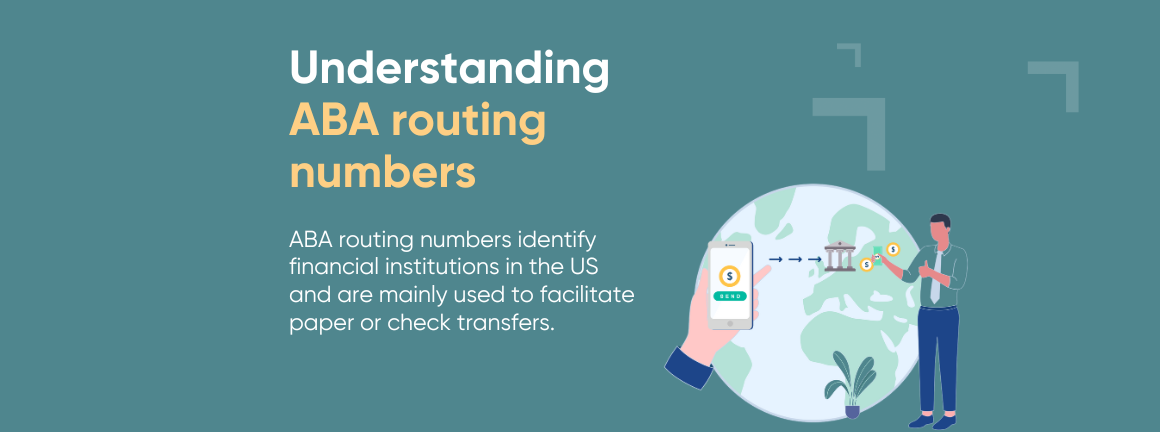
An ABA routing number is a 9-digit bank number that identifies a US bank. It is also called a routing transit number or RTN, and is used in multiple financial transactions across the United States, including paper checks and transfers.
To be assigned an ABA routing number, the banks must be federal or state-chartered financial institutions, which are eligible for a master account at the Federal Reserve Bank.
The ABA routing number was introduced by the American Bankers Association in 1910 and was initially developed to identify check processing endpoints. Since then, it has expanded its role to identify participants in automated clearinghouses, electronic funds transfers as well as online banking.
Bank routing numbers are unique numbers that help identify financial institutions when making transactions. They enable an accurate and secure movement of funds between accounts.
There are different routing numbers used for various payment systems:
A routing number and an account number serve different purposes in banking. The routing number identifies the specific bank or financial institution where your account is held. The account number, on the other hand, identifies your individual account within that bank.
When you send or receive money, the routing number directs the transaction to the correct bank, while the account number ensures the funds go to the correct personal or business account. Together, they enable secure and accurate transfers. Some numbers, such as IBAN, combine both identifiers into one single number.
While ABA routing numbers are mainly used for paper or check transfers, ACH routing numbers are used for electronic transfers within the US. ACH stands for Automated Clearing House and offers multiple benefits for domestic transactions within the US.
The fees related to ACH processing are determined by the specific organisations conducting the transactions. While some financial institutions employ a flat fee system, ranging generally from about $0.20 to $1.50 per transaction, others charge a percentage-based fee, typically between 0.5% and 1.5% of the transaction amount. ACH transactions typically take about 1-2 business days for funds to be transferred between accounts.
The drawback: ACH payments are only available for businesses holding US bank accounts.
While an ABA routing number is used to identify financial institutions in the United States to facilitate transactions, an International Bank Account Number (IBAN) is a standardised international system for identifying bank accounts. It is mainly used in Europe for cross-border transactions. As of December 2023, 86 countries are using the IBAN system.
The IBAN includes a country code, a two-digit checksum, and the individual bank account number, providing a unique identification for bank accounts involved in international transfers to ensure accuracy and efficiency in transactions between different countries. SEPA (Single Euro Payments Area) is the most common local payment scheme, which uses IBANs.
The ABA Routing Number is only used for transactions inside the US. If you need to make international transfers, the SWIFT network is the most commonly used system. SWIFT stands for Society for Worldwide Interbank Financial Telecommunication and uses the SWIFT/BIC code to identify the recipient bank.
The problem: SWIFT charges a hefty foreign transaction fee. When sending money to a different account abroad, the SWIFT system establishes an itinerary of up to 3 intermediary banks, through which the funds pass until they reach their final destination. This process is not only time-consuming, but also costly, as many different banks are involved in the process.
Therefore, try to avoid SWIFT payments and use local payment schemes instead, such as ACH in the US or SEPA in Europe.
Locating your ABA routing number is straightforward. The most common ways to find your ABA routing number are as follows:
As an international payment provider, amnis enables you to make use of ACH, even if you don’t have a business bank account USA, for faster payments at much lower costs compared to the SWIFT network. amnis allows you to set up automated hedging options to mitigate exchange rate risk for US dollar payments. If you frequently travel to the US, consider using an amnis multi-currency debit card to benefit from 0% FX fees, no foreign transaction charges, and top-tier security standards.
Visit our website to learn how you can save with local payment schemes in the US, Europe, and beyond – and try a free demo account at your convenience.